There is perfume in the garden,
and a rustling in the trees,
as the atmosphere is scented
by a fickle summer breeze.
There is magic in the moonlight,
purple shadows everywhere,
and the cries of ring-tailed possums,
in the bush, cut through the air.
On the mango trees the ripening fruit
is touched by pearly glow,
and the feasting flying-foxes
squeak and quarrel as they go.
Where the heady honeysuckle
lets a drift of blossoms fall,
the cascading golden creeper
spreads enchantment over all.
By the creek the giant red-gums stand,
like ancient dream-time guards at bay,
and the possums slip among the leaves,
to slumber through the day.
As the lushness of the waning night
envelops me like rain,
I can feel my heart is beating out
a tumultuous refrain.
For scenes of youth can never be
replaced by memory,
and home is where the exiled heart
must ever long to be.
Thursday, December 27, 2007

Wednesday, December 26, 2007
Christmas Eve
'Twas the night before Christmas, when all through the house
Not a creature was stirring, not even a mouse;
The stockings were hung by the chimney with care,
In hopes that St. Nicholas soon would be there;
The children were nestled all snug in their beds...


Sure - they're big teenagers now. :)
Not a creature was stirring, not even a mouse;
The stockings were hung by the chimney with care,
In hopes that St. Nicholas soon would be there;
The children were nestled all snug in their beds...


Sure - they're big teenagers now. :)
Sunday, December 16, 2007
Grandma's House
If I sit very still, just as still as a mouse,
I can slip through the years into Grandma’s house:
Jump over the miles and slide down the years,
to my memory-land of laughter and tears.
Just a white-painted cottage with a white picket fence
and red-galvanised roof. There was no nonsense
about that little house – two small rooms on each side
and a long room out back. It was perfect to slide
in my socks, on linoleum that glistened like glass,
past all the doorknobs of fresh-polished brass.
Such good fun it was, in those doorknobs to stare
at my oddly-shaped image reflected there.
At the end of the hall hung a glittery thing –
a curtain of beads that would jingle and ring;
always swirling, ensnaring, then setting me free,
when shrill joyous laughter would well up in me.
In the small sitting-room there were plush armchairs.
On the arms and the backs were placed dainty squares
of ‘fancy-worked’ linen, with crocheted bands,
to catch macassar-oiled hair or little soiled hands.
Grandma’s gramophone always held pride of place
on its table with cover of velvet and lace.
While ‘His Master’s Voice’ sounded from wall to wall,
Toby Dog in its centre was my all-in-all.
In Grandma’s kitchen there stood a big hutch
made of pinewood, well-polished and filled with such
colourful treasures to pleasure the eye.
There was fine china painted with grapes, placed high
above porcelain, gold-edged, and with flowers gay,
next to blue and white earthenware, used every day.
This told the sad story of lovers who fled,
and were turned into doves flying overhead.
At the back of the house all the windows were bright
with square green and gold panes, lined with black lead-light.
And the prisms of the lamp, as the sun shone through,
became miniature rainbows of every hue.
In the yard downstairs there were paw-paw trees,
with their fans arching out to the passing breeze.
And whenever the yellow-gold fruit hung there,
we would pick some for lunch, and I’d have a share.
And my dear Uncle Tom would be whistling so clear,
All those old-fashioned songs which delighted my ear.
There’d be music-hall ditties and ‘Mother Machree,’
‘Sally in our Alley,’ and ‘My Rosary.’
It is pleasant to picture one’s childhood, I find,
as long-vanished loved ones, and scenes, come to mind.
But the dearest of all of the pictures I see,
is the one of my Grandma’s face, smiling at me.
 (I wrote this poem in 1942 when I was eighteen years old, and stationed at R.A.A.F. W.T. Sigs, in Townsville, North Queensland. This was a frightening time in World War II. The A.I.F. ‘Desert Rats’ were recalled from North Africa and sent to New Guinea to reinforce Australian soldiers, striving alone to halt the seemingly unstoppable, and inhumanly cruel, Japanese advance through the islands to our north. Wounded men were sent by train regularly to hospitals in Brisbane. After the severe bombing of Darwin, with hundreds of people killed, our Government considered the feasibility in the event of invasion, of defending Australia ‘up to The Brisbane Line’. The situation of the Allies against the Axis Powers was grim on all fronts. Japan’s destruction of the U.S. Fleet in Hawaii in late 1941, without declaring war, brought the United States into the war in the Pacific, with intensification of the war effort, to the relief and benefit of Australia. Some 1,000,000 Americans had passed through Australia on their way north, by the end of the war.
When Japanese planes tried to bomb the oil tanks on the shore at Townsville, I lost my childhood feeling of being safe from harm. I had enlisted in the W.A.A.F. expecting to have a great adventure, but those expectations were quickly dashed by the frightful reality of war. Sightings of allied aircraft straggling back to Base, often with some missing after encounters with Japanese planes or warships, is with me still. So too, are my later memories as a medical secretary with the U.S. Air Force on Okinawa. Japanese prisoners in gray overalls and forage caps still lined up under guard at the Dispensary for examination. ‘Kamikaze’ planes stuck up at all angles from the sea and, off the roads or beaten tracks, Japanese landmines still claimed lives. When a weapons carrier was blown up close by, wreckage landed on the dispensary roof. There were wrecked U.S. planes, abandoned heavy weaponry, and some twenty thousand white crosses of American dead.)
I can slip through the years into Grandma’s house:
Jump over the miles and slide down the years,
to my memory-land of laughter and tears.
Just a white-painted cottage with a white picket fence
and red-galvanised roof. There was no nonsense
about that little house – two small rooms on each side
and a long room out back. It was perfect to slide
in my socks, on linoleum that glistened like glass,
past all the doorknobs of fresh-polished brass.
Such good fun it was, in those doorknobs to stare
at my oddly-shaped image reflected there.
At the end of the hall hung a glittery thing –
a curtain of beads that would jingle and ring;
always swirling, ensnaring, then setting me free,
when shrill joyous laughter would well up in me.
In the small sitting-room there were plush armchairs.
On the arms and the backs were placed dainty squares
of ‘fancy-worked’ linen, with crocheted bands,
to catch macassar-oiled hair or little soiled hands.
Grandma’s gramophone always held pride of place
on its table with cover of velvet and lace.
While ‘His Master’s Voice’ sounded from wall to wall,
Toby Dog in its centre was my all-in-all.
In Grandma’s kitchen there stood a big hutch
made of pinewood, well-polished and filled with such
colourful treasures to pleasure the eye.
There was fine china painted with grapes, placed high
above porcelain, gold-edged, and with flowers gay,
next to blue and white earthenware, used every day.
This told the sad story of lovers who fled,
and were turned into doves flying overhead.
At the back of the house all the windows were bright
with square green and gold panes, lined with black lead-light.
And the prisms of the lamp, as the sun shone through,
became miniature rainbows of every hue.
In the yard downstairs there were paw-paw trees,
with their fans arching out to the passing breeze.
And whenever the yellow-gold fruit hung there,
we would pick some for lunch, and I’d have a share.
And my dear Uncle Tom would be whistling so clear,
All those old-fashioned songs which delighted my ear.
There’d be music-hall ditties and ‘Mother Machree,’
‘Sally in our Alley,’ and ‘My Rosary.’
It is pleasant to picture one’s childhood, I find,
as long-vanished loved ones, and scenes, come to mind.
But the dearest of all of the pictures I see,
is the one of my Grandma’s face, smiling at me.
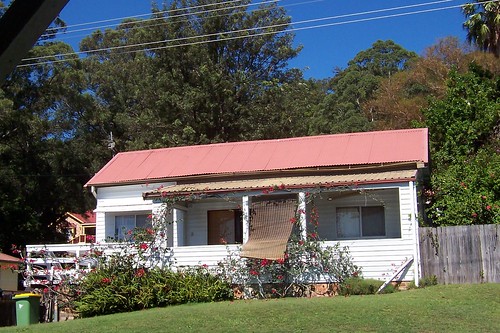 (I wrote this poem in 1942 when I was eighteen years old, and stationed at R.A.A.F. W.T. Sigs, in Townsville, North Queensland. This was a frightening time in World War II. The A.I.F. ‘Desert Rats’ were recalled from North Africa and sent to New Guinea to reinforce Australian soldiers, striving alone to halt the seemingly unstoppable, and inhumanly cruel, Japanese advance through the islands to our north. Wounded men were sent by train regularly to hospitals in Brisbane. After the severe bombing of Darwin, with hundreds of people killed, our Government considered the feasibility in the event of invasion, of defending Australia ‘up to The Brisbane Line’. The situation of the Allies against the Axis Powers was grim on all fronts. Japan’s destruction of the U.S. Fleet in Hawaii in late 1941, without declaring war, brought the United States into the war in the Pacific, with intensification of the war effort, to the relief and benefit of Australia. Some 1,000,000 Americans had passed through Australia on their way north, by the end of the war.
When Japanese planes tried to bomb the oil tanks on the shore at Townsville, I lost my childhood feeling of being safe from harm. I had enlisted in the W.A.A.F. expecting to have a great adventure, but those expectations were quickly dashed by the frightful reality of war. Sightings of allied aircraft straggling back to Base, often with some missing after encounters with Japanese planes or warships, is with me still. So too, are my later memories as a medical secretary with the U.S. Air Force on Okinawa. Japanese prisoners in gray overalls and forage caps still lined up under guard at the Dispensary for examination. ‘Kamikaze’ planes stuck up at all angles from the sea and, off the roads or beaten tracks, Japanese landmines still claimed lives. When a weapons carrier was blown up close by, wreckage landed on the dispensary roof. There were wrecked U.S. planes, abandoned heavy weaponry, and some twenty thousand white crosses of American dead.)
Geraniums love walls
Geraniums love walls
They seem to look their best
In front of ancient bricks -
Like painted soldiers, drest
And stiffly on parade.
Each scarlet bloom's a cockade,
On a blade of green.
They make one say:
"Who would ever dream
an old brick wall
could look so gay?"

They seem to look their best
In front of ancient bricks -
Like painted soldiers, drest
And stiffly on parade.
Each scarlet bloom's a cockade,
On a blade of green.
They make one say:
"Who would ever dream
an old brick wall
could look so gay?"

Marcelle's response to the Mazda's departure
Requiem for a Friend:
Death came as the end
for a trusty old friend.
Like the stump of a tree,
of a long-felled tree,
she served for a time
as a resting-place
for a boy and his mates
to gather and share
their youthful dreams.
Unfailing to the last,
as she had been
in the past,
the old car gave her all -
those small gains
from the sale
of her remains
to the wreckers.

Death came as the end
for a trusty old friend.
Like the stump of a tree,
of a long-felled tree,
she served for a time
as a resting-place
for a boy and his mates
to gather and share
their youthful dreams.
Unfailing to the last,
as she had been
in the past,
the old car gave her all -
those small gains
from the sale
of her remains
to the wreckers.
Saturday, October 13, 2007
Honeysuckle Moments
I was once a stenographer for four years, in a town in the red earth outback.
I walked to and from work, waving off sticky flies in the hot summer days,
past dilapidated palings, unpainted by time, enclosing a ruinous homestead,
with its outhouses, cookhouse and stables and smithy, all crumbling away.
In the derelict fowl house and run, rusty chicken wire hung from skewed posts.
Unrestrained, a bougainvillea, rust-red, canopied a collapsing gazebo.
For a century this formed the hub of a sheep, and then cattle station,
that extended for many square acres of land, almost into the town.
Once-white paint peeled from walls and french windows, to the floor below.
From still-lovely wrought iron of lace railings, white flakes floated down
on the splintery wood of the wide ‘wrap-around’ verandah floor.
Still tin-capped, hardwood stumps were subsiding in red earth below.
With the death of the owner, the only descendant of pioneer squatters
who established the property, no repairs ever had been done to the place.
So when rotting front porch and front stairs were pristinely restored,
rumour said that this could be the work of the Historic Building Trust.
For a few days bikini-clad models were observed there, prettily posing
for the cameras, advertising sundry wares, for the wry entertainment
of the locals. But afterwards homestead and outhouses went on decaying
through all seasons, as its second century came and its first century went.
I had gone on my annual leave when the homestead was razed, and returned
to find only a few heaps of rubble, with bits of white lace iron, remaining.
But behind weathered palings, the outhouses still seemed untroubled,
with the same rotting tackle suspended from warped stable walls.
Once red-painted, now rusting, tin roofs still supported a rampant green mass
of old vines. Suddenly, a momentary upsurge of joy caught me all unaware,
when the sweet scent of orange-gold blossoms in the air filled my senses,
and nostalgia brought scenes from times long gone by to my mind.
In that harsh, outback clime, at beginning and end of mundane work days,
I would linger at times by that ruinous fence, inhaling the sweet scented air.
And for years, whenever my dreams were honeysuckle tendril entwined,
waking, I yearned for more honeysuckle-scented moments in my life.
I walked to and from work, waving off sticky flies in the hot summer days,
past dilapidated palings, unpainted by time, enclosing a ruinous homestead,
with its outhouses, cookhouse and stables and smithy, all crumbling away.
In the derelict fowl house and run, rusty chicken wire hung from skewed posts.
Unrestrained, a bougainvillea, rust-red, canopied a collapsing gazebo.
For a century this formed the hub of a sheep, and then cattle station,
that extended for many square acres of land, almost into the town.
Once-white paint peeled from walls and french windows, to the floor below.
From still-lovely wrought iron of lace railings, white flakes floated down
on the splintery wood of the wide ‘wrap-around’ verandah floor.
Still tin-capped, hardwood stumps were subsiding in red earth below.
With the death of the owner, the only descendant of pioneer squatters
who established the property, no repairs ever had been done to the place.
So when rotting front porch and front stairs were pristinely restored,
rumour said that this could be the work of the Historic Building Trust.
For a few days bikini-clad models were observed there, prettily posing
for the cameras, advertising sundry wares, for the wry entertainment
of the locals. But afterwards homestead and outhouses went on decaying
through all seasons, as its second century came and its first century went.
I had gone on my annual leave when the homestead was razed, and returned
to find only a few heaps of rubble, with bits of white lace iron, remaining.
But behind weathered palings, the outhouses still seemed untroubled,
with the same rotting tackle suspended from warped stable walls.
Once red-painted, now rusting, tin roofs still supported a rampant green mass
of old vines. Suddenly, a momentary upsurge of joy caught me all unaware,
when the sweet scent of orange-gold blossoms in the air filled my senses,
and nostalgia brought scenes from times long gone by to my mind.
In that harsh, outback clime, at beginning and end of mundane work days,
I would linger at times by that ruinous fence, inhaling the sweet scented air.
And for years, whenever my dreams were honeysuckle tendril entwined,
waking, I yearned for more honeysuckle-scented moments in my life.
Subscribe to:
Posts (Atom)


